Central Florida Health and Wellness Magazine Health and Wellness Articles of the Villages
Related Articles


 Chronic venous insufficiency (CVI) rarely announces itself with a single dramatic symptom. It builds slowly, tired legs after a long day, faint swelling around the ankles, skin that feels tight by evening. Because these signs are so easy to dismiss, one of CVI’s most serious complications often goes unnoticed until it’s already a problem: the venous leg ulcer.
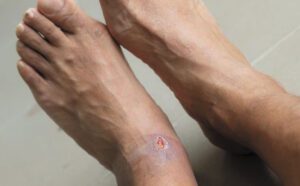
Venous leg ulcers (VLUs) are open wounds that develop when damaged vein valves allow blood to pool in the lower legs instead of returning efficiently to the heart. They account for the majority of chronic leg wounds, yet they’re frequently mistaken for a slow-healing scrape or an unrelated skin issue, a mix-up that can delay proper care by months.
How a Vein Problem Becomes a Wound
Healthy veins rely on one-way valves to push blood upward against gravity. When those valves weaken or fail, often the result of long-standing varicose veins, prior blood clots, or years of prolonged standing or sitting, blood begins to back up and pool near the ankles. The resulting pressure buildup, known as venous hypertension, pushes fluid and blood cells out into the surrounding tissue.
Over time, this trapped fluid deprives the skin of the oxygen and nutrients it needs to stay intact. The tissue becomes fragile, discolored, and increasingly prone to breaking down. Eventually, even a minor bump or scrape in the area can open into a wound that won’t close on its own, this is a venous leg ulcer.
Recognizing the Signs
Venous leg ulcers have a fairly distinct presentation, and learning to recognize the early warning signs can make a real difference in outcomes.
Typical features include:
• A shallow, irregularly shaped wound, usually near the inner ankle
• A red or yellowish base, sometimes with weeping or drainage
• Surrounding skin that appears shiny, tight, brown, or hardened
• Swelling, aching, or a heavy sensation in the affected leg
• Itchy or discolored patches in the weeks before a wound actually forms
That last point is worth emphasizing: many patients notice changes in their skin — hardening, discoloration, persistent itching, well before an ulcer appears. These early clues are the body’s way of signaling that venous pressure has already reached a damaging level, and they’re the ideal moment to intervene before a wound forms at all.
Why These Wounds Are Often Overlooked
Unlike a fresh cut, a venous ulcer doesn’t always look alarming at first. It can resemble a scrape that’s simply taking its time to heal, which leads many people to treat it with basic first aid and wait. But venous ulcers don’t heal like ordinary wounds, the underlying pressure problem persists, so the skin keeps breaking down faster than it can repair itself. Left unaddressed, a small sore can slowly enlarge, become painful, and open the door to infection.
This is why timing matters so much. A wound that hasn’t shown real improvement after roughly two weeks, or one that’s growing, draining more, or developing an odor, deserves evaluation from a vein specialist, not just a bandage change.
Treating the Wound and the Root Cause
Effective care for a venous leg ulcer has to address two things at once: the open wound itself and the venous pressure problem driving it. Wound-focused care typically involves regular cleaning and dressing changes to control infection risk and support new tissue growth.
At the same time, managing the underlying venous insufficiency is what allows healing to actually stick. Compression therapy is the cornerstone here, compression stockings or wraps counteract the pooling pressure in the leg, giving damaged skin a real chance to repair itself. For more advanced or recurrent cases, minimally invasive procedures like endovenous laser treatment, sclerotherapy, or Venaseal can close off the malfunctioning vein entirely, reducing the pressure that caused the ulcer in the first place and lowering the risk of it coming back.
Don’t Wait for the Wound to Get Worse
Venous leg ulcers are a visible sign of an underlying circulation problem that’s been building for a while, but they’re also highly treatable, especially when caught early. If you’re noticing swelling, skin changes, or a wound on your lower leg that isn’t healing the way it should, it’s worth having your veins evaluated rather than waiting to see if it resolves on its own. A proper diagnostic ultrasound can identify exactly which veins are contributing to the problem, opening the door to a treatment plan built around lasting relief, not just wound care in isolation.
Central Florida Vein & Vascular Center
(352) 562-0078 . www.cfvein.com
13953 NE 86th Terrace, Unit 101
Lady Lake, FL 32159
MOST PROCEDURES ARE COVERED BY INSURANCE
Convenient Golf Cart Path Access