Central Florida Health and Wellness Magazine Health and Wellness Articles of the Villages
Related Articles


 Every 40 seconds, someone in the United States has a stroke. Every 3.5 minutes, someone dies from one. Stroke is the fifth-leading cause of death in the country and a leading cause of long-term disability — and yet, up to 80 percent of strokes are preventable. More importantly, when a stroke does occur, the speed of treatment can mean the difference between full recovery and permanent impairment. That is the driving force behind one of the most groundbreaking tools in emergency medicine today: the UF Health Mobile Stroke Treatment Unit.
What Is a Mobile Stroke Treatment Unit?
A Mobile Stroke Treatment Unit is essentially a hospital emergency room on wheels. Deployed by UF Health — part of the University of Florida Health system — the Mobile Stroke Treatment Unit is a specially designed ambulance equipped with a CT scanner, telemedicine capabilities and the stroke medications and staff needed to begin treatment before a patient ever reaches the hospital. The unit is staffed by a specialized team that includes a critical care paramedic, a CT technologist and a registered nurse, with a vascular neurologist available via telemedicine in real time.
This mobile approach allows clinicians to diagnose a stroke at the scene, administer clot-busting drugs known as tPA (tissue plasminogen activator) and in some cases, coordinate emergency interventional procedures, all while the patient is en route to the hospital. The result: dramatically reduced treatment times and significantly better patient outcomes.
Time Is Brain
For every minute a stroke goes untreated, there’s a phrase that defines everything: “Time is brain.” An estimated 1.9 million neurons are lost. In traditional emergency care, a patient must be transported to a hospital, evaluated, sent for imaging and then diagnosed before treatment can begin — a process that can take an hour or more. The UF Health Mobile Stroke Treatment Unit collapses that timeline dramatically.
May is American Stroke Month — a time to raise awareness, recognize warning signs and celebrate the innovations that are changing outcomes for stroke patients.
By bringing advanced diagnostics directly to the patient, the Mobile Stroke Treatment Unit can reduce treatment times by as much as 60 percent compared to standard emergency care. Studies on mobile stroke units have shown that patients treated via Mobile Stroke Treatment Unit are more likely to achieve functional independence and experience reduced disability three months after their stroke. For a condition where seconds truly count, this is nothing short of life-changing.
UF Health’s Commitment to Stroke Innovation
UF Health has long been recognized as a leader in stroke care. The health system’s comprehensive stroke centers meet the highest standards for stroke diagnosis, treatment and rehabilitation. The Mobile Stroke Treatment Unit represents the next frontier of that commitment — extending expert neurological care beyond hospital walls and into the community at the moment it is needed most.
The Mobile Stroke Treatment Unit operates in coordination with local emergency medical services, responding to 911 calls involving suspected stroke symptoms. Once on scene, the team uses the onboard CT scanner to distinguish between ischemic
strokes — caused by a blood clot — and hemorrhagic strokes, which are caused by bleeding in the brain, as the two require entirely different treatments. This critical differentiation, which once required a hospital visit, is now happening in a driveway or on a neighborhood street.
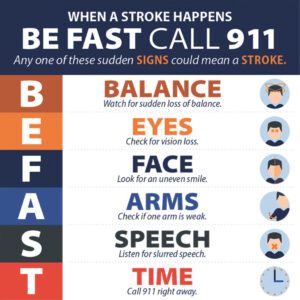
Know the Signs — BE FAST
Even with the most advanced mobile unit in the field, early recognition of stroke symptoms by bystanders and patients remains critical. The American Stroke Association urges everyone to remember the acronym BE FAST:
B — Balance: Watch for a sudden loss of balance.
E — Eyes: Check for vision loss.
F — Face drooping: Is one side of the face numb or drooping?
A — Arm weakness: Is one arm weak or numb?
S — Speech difficulty: Is speech slurred or hard to understand?
T — Time to call 911: Call immediately if any of these signs are present.
When you call 911 in areas served by the UF Health Mobile Stroke Treatment Unit, dispatchers can route the specialized unit directly to the scene — putting expert stroke care in motion before a patient ever arrives at the emergency room.
A Future Where Fewer Strokes Mean Lasting Disability
This American Stroke Month, UF Health’s Mobile Stroke Treatment Unit stands as a powerful symbol of what is possible when medical innovation meets community commitment. By putting a CT scanner on wheels, connecting paramedics with neurologists via telemedicine and responding to emergencies with the same urgency and expertise as the hospital itself, UF Health is rewriting what it means to survive a stroke.
The mission is clear: fewer strokes, faster treatment and more lives fully lived. Because when every second counts, the best emergency room is the one that comes to you.
UFHealth – University of Florida Health